
It usually happens on a Saturday. You're reaching down to grab a cooler or a bag of mulch, half under the door as it closes, and it just... keeps coming. No pause, no reverse, nothing. You yank your arm back, the door finishes closing, and now you're standing in the driveway saying some version of "we need a new garage door" while your spouse says "it's been doing that for twenty years, it's fine." You're both a little bit right.
A garage door from the 1990s or earlier isn't automatically dangerous just because it's old. Plenty of them are structurally solid — heavier gauge steel, simpler mechanisms, fewer things to break. But a handful of safety features that are now standard simply didn't exist yet on older units, and those are worth taking seriously. Everything else is a judgment call.
What's actually a safety issue
No auto-reverse sensors
If your opener doesn't have a pair of small photo-eye sensors mounted a few inches off the floor on each side of the track, the door has no way of knowing something — or someone — is in its path. This is the single biggest retrofit worth doing on an old system. A new opener with auto-reverse and sensors is a self-contained fix and doesn't require replacing the door itself.
No manual quick-release testing
Every door should have a red release cord on the opener trolley that disconnects the door from the motor in a power outage or jam. On older setups, that cord sometimes gets tied up, painted over, or forgotten. Test it. If it's stiff, seized, or missing, that's a retrofit, not a "leave it alone."
Exposed, uncontained springs
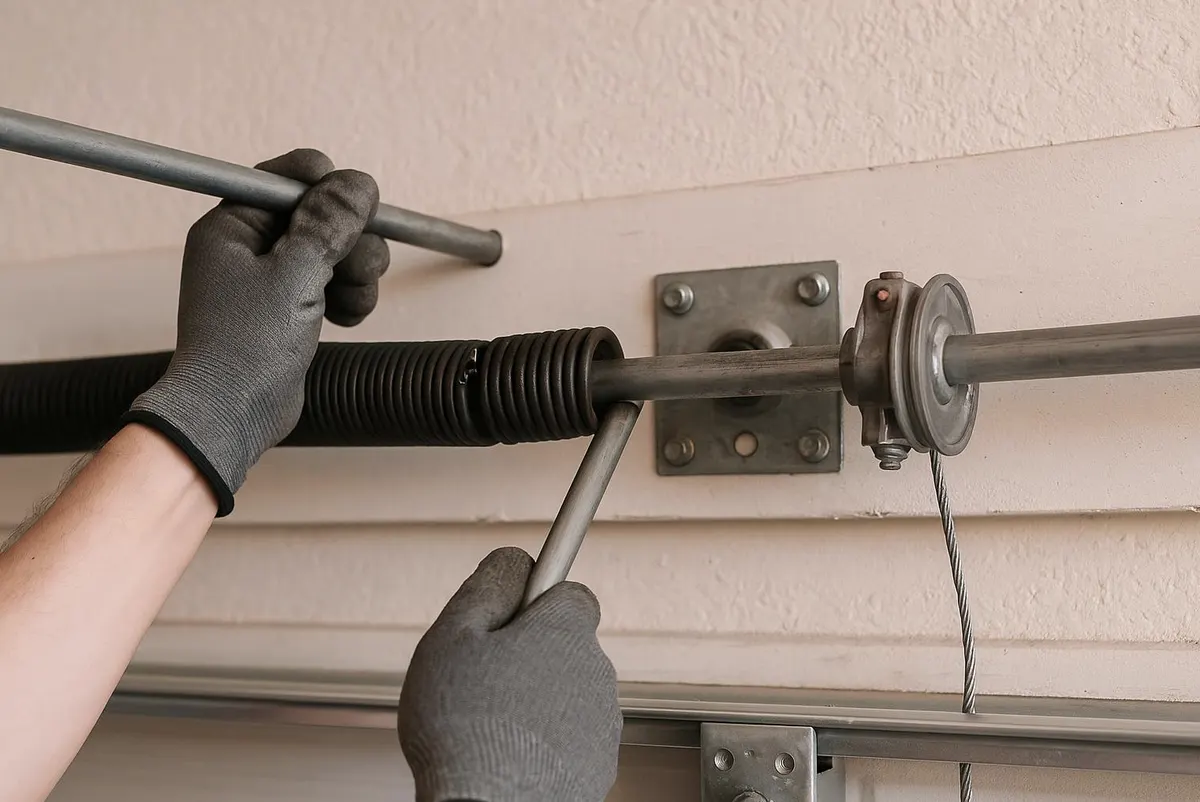
Older torsion and extension springs were sometimes installed without a safety cable running through the center. If a spring like that snaps under tension, it can whip or send hardware flying. Containment cables are cheap insurance and a reasonable technician can usually add them without replacing the spring.
Wind-load bracing
This one matters more here than it does in a lot of the country. Doors built before Florida's modern wind-load expectations weren't engineered with hurricane gusts in mind. Reinforcement kits — horizontal struts bolted across the panels — can usually be retrofitted onto an existing door to stiffen it against wind pressure, instead of requiring a full replacement. It's one of the more practical upgrades for anyone in Highlands County who isn't ready to swap the whole door.
What's probably fine to leave alone
The panels themselves
If the door isn't rusted through, isn't delaminating, and still sits flush in the frame, the panels can likely ride out several more years. Cosmetic fading from sun exposure or a few dings don't affect how safely the door operates.
Original tracks and rollers, if they're aligned
Old steel rollers are noisier than today's nylon ones, but noise alone isn't a safety problem. If the door travels smoothly without binding or popping out of the track, there's no urgent reason to replace them — a little lubrication goes a long way.
Manual operation
Some older doors were never motorized and still open by hand with a lock bar. That's not inherently unsafe; it's just inconvenient. Whether to add an opener is a lifestyle decision, not a safety one.
Where Florida humidity changes the math
Heat and moisture speed up wear on anything metal or wood. Hardware that would last decades in a dry climate can develop surface rust here within a few years, especially on doors that sit a little closer to damp ground or get regular afternoon downpour runoff near the base. If hinges, hinge screws, or the bottom bracket are rusted to the point of flaking, that's a safety issue regardless of the door's age — rusted hardware under spring tension is not something to wait on. A wood door that's swollen at the bottom corners from repeated humidity exposure is also worth addressing before it starts dragging on the track and straining the opener.
When to call Sebring Garage Door
If the argument in your garage comes down to "does this need a sensor, a brace, or a whole new door," that's exactly the kind of call worth making before anyone guesses wrong. We handle Garage Door Opener Installation for homes still running on original 1990s hardware, and we do full Garage Door Maintenance & Tune-Ups that catch rusted hinges, loose brackets, and missing containment cables before they turn into a bigger repair. We'll tell you straight which parts are fine to leave and which ones aren't worth the risk, no upsell required.
If your garage door is older than your car and you're not sure which category it falls into, give Sebring Garage Door a call. We serve Sebring, Avon Park, Lake Placid, Frostproof, Wauchula, Bowling Green, Lorida, and Venus, and we're happy to come take a look and settle the debate.